
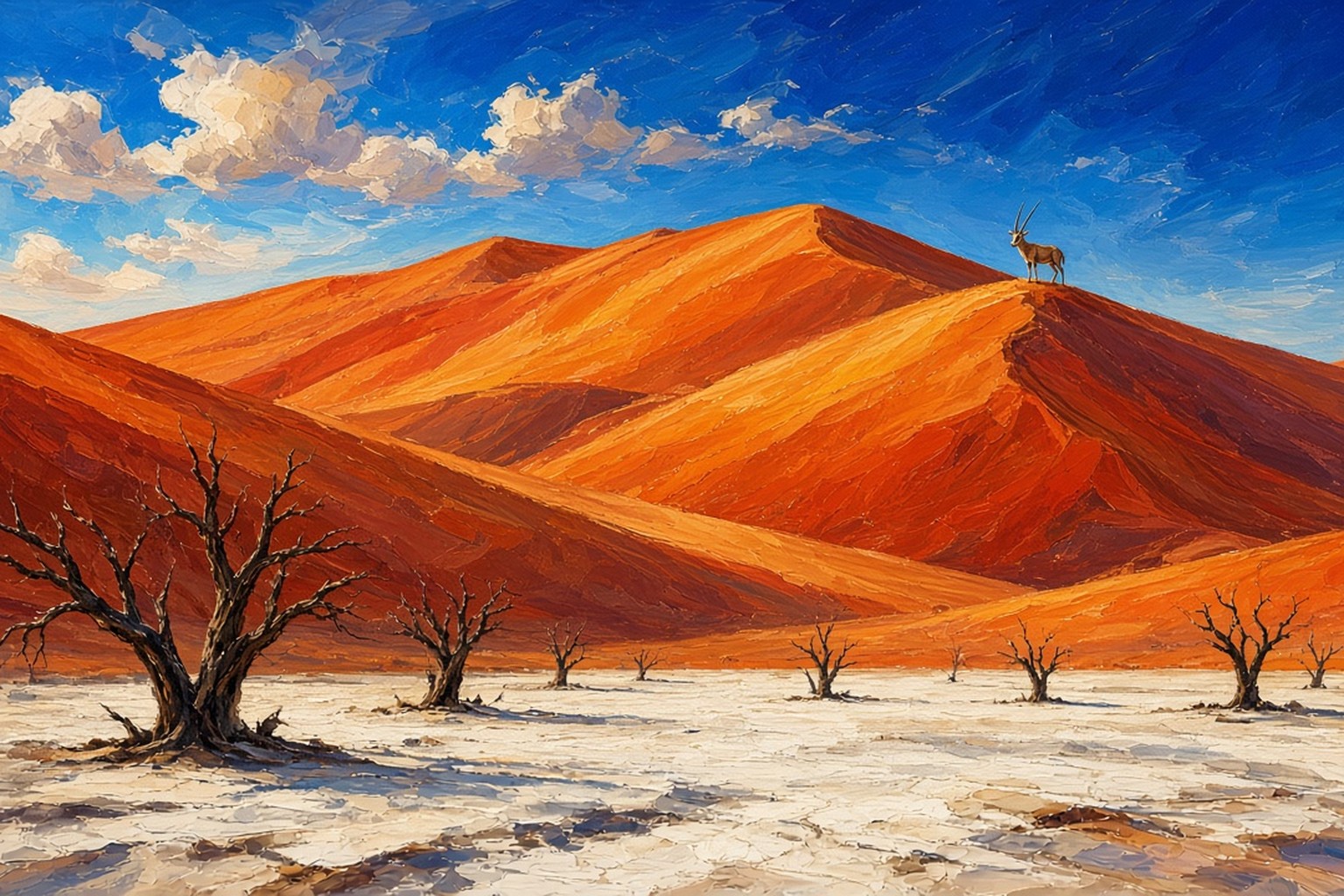
Namibia is a vast and spectacular country in southwestern Africa, where towering red dunes meet the cold waters of the Atlantic Ocean. Home to the Namib, often described as the oldest desert in the world, it is famous for its wide open spaces, remarkable wildlife, and star-filled night skies. With its diverse cultures, peaceful atmosphere, and strong commitment to conservation, Namibia is one of Africa’s most breathtaking destinations.
Geography and Climate
Namibia covers about 825,000 square kilometers and is bordered by Angola, Zambia, Botswana, and South Africa, with a long coastline on the Atlantic Ocean. A narrow strip of land in the northeast, known as the Zambezi Region, reaches toward the Zambezi River.
The Namib Desert stretches along the entire coast, while the Kalahari Desert extends across the east. Between them lies a central plateau of mountains, plains, and dry riverbeds, where the capital, Windhoek, is located. The highest point, Königstein on the Brandberg massif, rises to about 2,573 meters, and the Orange and Kunene rivers form parts of the southern and northern borders.
Namibia has one of the driest climates in Africa, with hot days, cool nights, and very little rainfall in most areas. The cold Benguela Current along the coast creates frequent fog that supports unique desert plants and animals. With so few people and clear skies, Namibia is among the least densely populated countries in the world.
History and Independence
The San people have lived in the region for thousands of years, and their ancient rock engravings at Twyfelfontein are a UNESCO World Heritage Site. Over time, other groups such as the Ovambo, Herero, Nama, and Damara settled across the land.
In 1884, the territory became the German colony of German South West Africa. Between 1904 and 1908, colonial forces brutally suppressed uprisings by the Herero and Nama peoples, a tragedy that Germany formally acknowledged as genocide in 2021.
After the First World War, South Africa took control of the territory under a League of Nations mandate. A long struggle for independence, led by SWAPO, ended when Namibia became independent on 21 March 1990, with Sam Nujoma as its first president. In 2025, Netumbo Nandi-Ndaitwah became the country’s first female president.
Economy and Natural Resources
Mining is the backbone of Namibia’s economy, with diamonds, uranium, zinc, gold, and copper among its main exports. Many of its high-quality diamonds are recovered from the seabed off the southern coast.
Fishing in the rich waters of the Atlantic is another major industry, and cattle and goat farming are important in rural areas. Tourism also provides many jobs, especially in lodges and safari camps.
In recent years, significant offshore oil discoveries have been made, and Namibia is developing projects in green hydrogen and solar power. The Namibian dollar is linked to the South African rand, and Walvis Bay is the country’s main port.
Culture and Language
English is the official language, chosen at independence to unite the nation, while Oshiwambo, Afrikaans, Otjiherero, Khoekhoegowab, and German are also widely spoken. Most Namibians are Christians, and many people also honor traditional customs and beliefs.
The Himba people of the northwest are known for covering their skin and hair with otjize, a reddish paste of butterfat and ochre. Herero women often wear long, colorful dresses and distinctive horn-shaped headdresses, a style that has become a proud symbol of identity.
Music, dance, and storytelling are important parts of community life, and traditional crafts include basketry, beadwork, and wood carving. Namibia’s constitution was one of the first in the world to include protection of the environment.
Food and Cuisine
Namibian cuisine reflects both African traditions and German influences from the colonial era. Kapana, strips of beef grilled over open fires and served with spicy sauces at street markets, is a popular favorite, especially in Windhoek.
Oshifima, a stiff porridge made from mahangu, or pearl millet, is a staple in the north, often eaten with meat or vegetable stews. Biltong, dried and spiced meat, is a popular snack, and game meats such as kudu and oryx are served in many restaurants.
German-style breads, pastries, and sausages remain common, especially in towns such as Swakopmund. Along the coast, fresh oysters from Walvis Bay and Lüderitz are a local delight.
Tourism and Attractions
Sossusvlei, in the heart of the Namib Desert, is famous for its towering red dunes and the white clay pan of Deadvlei, dotted with ancient dead trees. Etosha National Park, built around a vast salt pan, is one of Africa’s great wildlife areas, where elephants, lions, rhinos, and giraffes gather at waterholes.
The Fish River Canyon in the south is one of the largest canyons in the world, and the Skeleton Coast is known for its foggy shores and shipwrecks. Swakopmund offers colonial architecture and adventures such as sandboarding, quad biking, and scenic flights over the dunes.
Visitors can also explore the ghost town of Kolmanskop, see seals at Cape Cross, and track desert-adapted elephants in Damaraland. Many communities run conservancies that protect wildlife while earning income from tourism.
Challenges and Opportunities
Namibia faces challenges such as inequality, unemployment, and recurring droughts that affect farmers and water supplies. Ensuring that wealth from mining and new energy projects benefits all Namibians is an important goal.
At the same time, its stability, strong conservation record, abundant sunshine, and new oil and green hydrogen projects offer great opportunities. Sustainable tourism and investment in education could help Namibia build a prosperous future.
Namibia’s community conservancies have become a model for other countries, showing how local people can benefit directly from protecting wildlife. Expanding water infrastructure, skills training, and small businesses could help more families share in the country’s growth.
A Land of Ancient Dunes and Starlit Skies
Namibia is a land of glowing dunes, endless horizons, and wildlife roaming free beneath vast skies. From the red sands of Sossusvlei and the waterholes of Etosha to the misty Skeleton Coast and the lively streets of Windhoek, it offers wonders on a grand scale. Peaceful, proud, and breathtaking, Namibia is a true gem of Africa.