
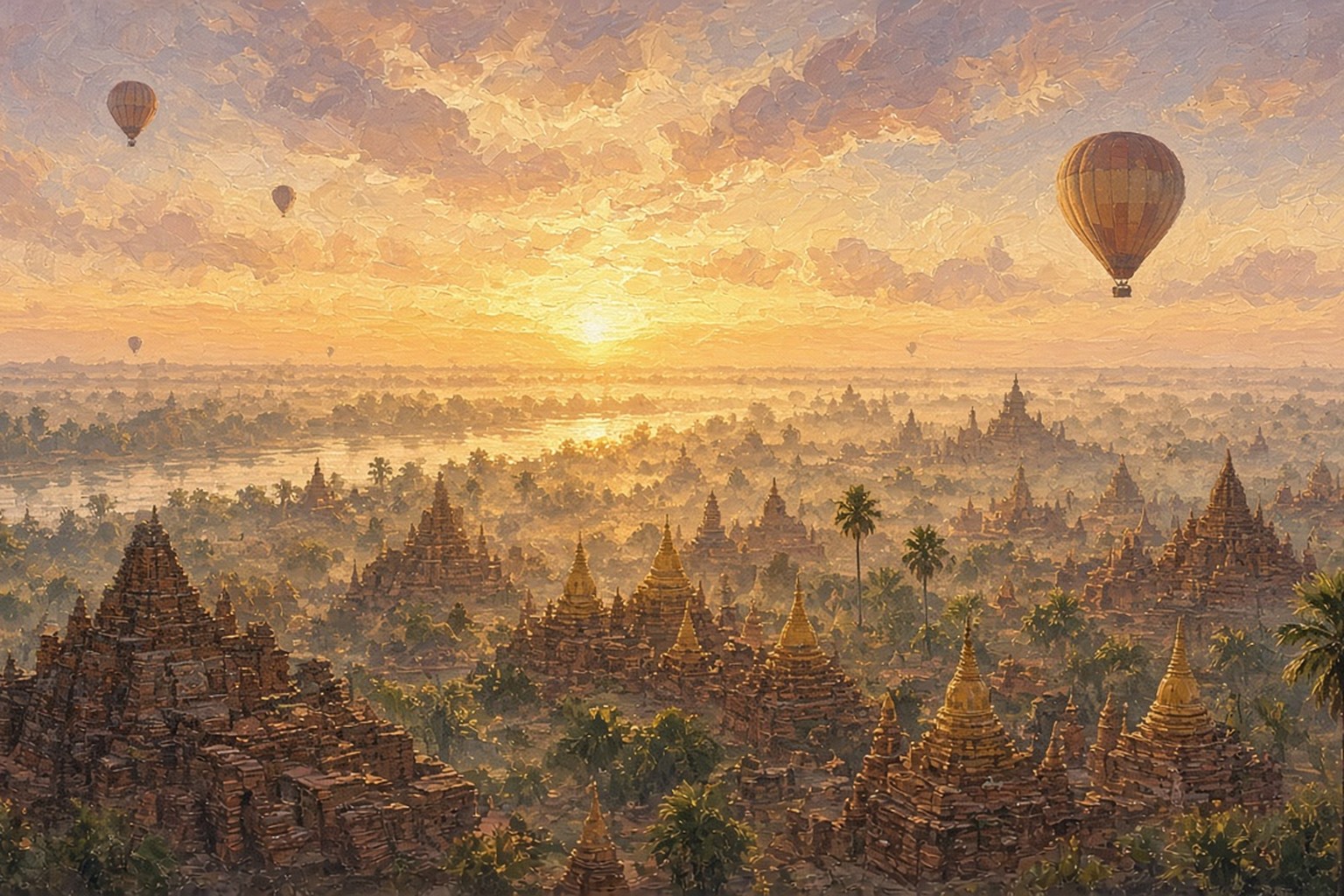
Myanmar, also known as Burma, is a large and diverse country in Southeast Asia, stretching from the snowy peaks of the eastern Himalayas to the warm shores of the Andaman Sea. Often called the “Golden Land,” it is famous for its shimmering pagodas, ancient temple plains, and deep Buddhist traditions. With its many ethnic cultures, flavorful cuisine, and gentle hospitality, Myanmar is one of Asia’s most fascinating countries.
Geography and Climate
Myanmar covers about 676,000 square kilometers, making it the largest country in mainland Southeast Asia. It is bordered by Bangladesh, India, China, Laos, and Thailand, and has a long coastline on the Bay of Bengal and the Andaman Sea.
Mountains form a horseshoe around the country, rising in the far north to Hkakabo Razi, the highest peak in Southeast Asia at almost 5,900 meters. The mighty Irrawaddy River flows from north to south through the central plains before spreading into a fertile delta. In the east, the Shan Plateau is home to green hills and lakes, and in the south, the Mergui Archipelago contains hundreds of islands.
The climate is tropical monsoon, with a hot season, a rainy season from about May to October, and a cooler, dry season. The central dry zone around Mandalay and Bagan receives much less rain than the coast. Forests cover a large part of the country and shelter rich wildlife.
History and Independence
Early civilizations, including the Pyu city-states, flourished in the Irrawaddy Valley more than two thousand years ago, and their ancient cities are now a UNESCO World Heritage Site. In the eleventh century, King Anawrahta united much of the region under the Pagan Kingdom, whose rulers built thousands of temples at Bagan.
Later kingdoms, including the Toungoo and Konbaung dynasties, ruled from cities such as Ava, Amarapura, and Mandalay. After three Anglo-Burmese wars in the nineteenth century, the country came under British rule and was governed as part of British India until 1937.
Led by independence leaders such as General Aung San, Burma gained independence on 4 January 1948. The military took power in 1962, and the country’s official English name was changed to Myanmar in 1989. A period of political opening began in the 2010s, but the military again seized power in 2021, and the country has since faced serious conflict and hardship.
Economy and Natural Resources
Agriculture is the backbone of Myanmar’s economy, and rice is grown across the fertile delta and river valleys. The country also produces beans, pulses, sesame, sugarcane, and fish.
Myanmar is rich in natural resources, including natural gas, timber such as teak, and precious stones. It is one of the world’s main sources of jade, and the Mogok region is famous for its deep red rubies.
Garment manufacturing, trade with neighboring countries, and small businesses provide jobs in cities such as Yangon and Mandalay. Since 2005, Naypyidaw has served as the capital and seat of government.
Culture and Language
The official language is Burmese, written in a rounded script, and many other languages are spoken by the country’s numerous ethnic groups, such as the Shan, Karen, Rakhine, Mon, Chin, and Kachin. Most people follow Theravada Buddhism, and monasteries play an important role in community life.
Many people wear the longyi, a traditional wrapped garment, and thanaka, a pale paste made from tree bark, is applied to the face for beauty and protection from the sun. Traditional arts include marionette puppetry, lacquerware, and music played on the elegant saung, a curved harp.
The most joyful festival is Thingyan, the water festival held in April to celebrate the traditional New Year. Thadingyut, the festival of lights in October, fills towns and pagodas with candles and lanterns.
Food and Cuisine
Burmese cuisine reflects influences from neighboring India, China, and Thailand, while keeping its own distinctive flavors. Mohinga, a fragrant fish and rice noodle soup flavored with lemongrass, is widely considered the national dish and is often eaten for breakfast.
Lahpet thoke, a salad of fermented tea leaves mixed with crunchy beans, peanuts, tomatoes, and garlic, is a beloved specialty served at home, in teahouses, and at special occasions. Shan noodles, mild curries, and fresh salads served with rice are everyday favorites.
Meals are usually shared, with many small dishes placed in the center of the table. Green tea is offered freely in teahouses, where friends gather to chat over sweet milk tea and snacks.
Tourism and Attractions
The golden Shwedagon Pagoda in Yangon, glowing on a hill above the city, is the most sacred Buddhist site in the country. Bagan, a UNESCO World Heritage Site, preserves thousands of ancient temples and stupas spread across a wide plain beside the Irrawaddy River.
Inle Lake in Shan State is known for its floating gardens, stilt villages, and fishermen who row with one leg. Other famous sights include the gilded Golden Rock at Kyaiktiyo, the royal city of Mandalay, and U Bein Bridge, a long teak footbridge near Amarapura.
Beaches such as Ngapali and the islands of the Mergui Archipelago offer clear waters and quiet shores. Travel conditions differ across the country, so visitors are advised to follow current travel guidance.
Challenges and Opportunities
Myanmar faces major challenges, including ongoing conflict, displacement of communities, economic difficulties, and the effects of natural disasters such as the powerful earthquake of March 2025 near Mandalay. Rebuilding trust and peace among its diverse communities remains the most important task.
At the same time, the country’s young population, fertile land, natural resources, and extraordinary cultural heritage offer great potential. With peace and stability, tourism, agriculture, and trade could help Myanmar build a brighter future.
Many communities are working to preserve their languages, crafts, and religious heritage for future generations. Protecting forests, rivers, and coastal ecosystems will also be important for the country’s long-term prosperity.
A Land of Golden Spires and River Mists
Myanmar is a land of shimmering pagodas, misty rivers, and timeless traditions. From the glowing Shwedagon Pagoda and the temple plains of Bagan to the floating gardens of Inle Lake, it holds treasures found nowhere else on Earth. Gentle, spiritual, and full of beauty, Myanmar remains one of the true wonders of Asia.