
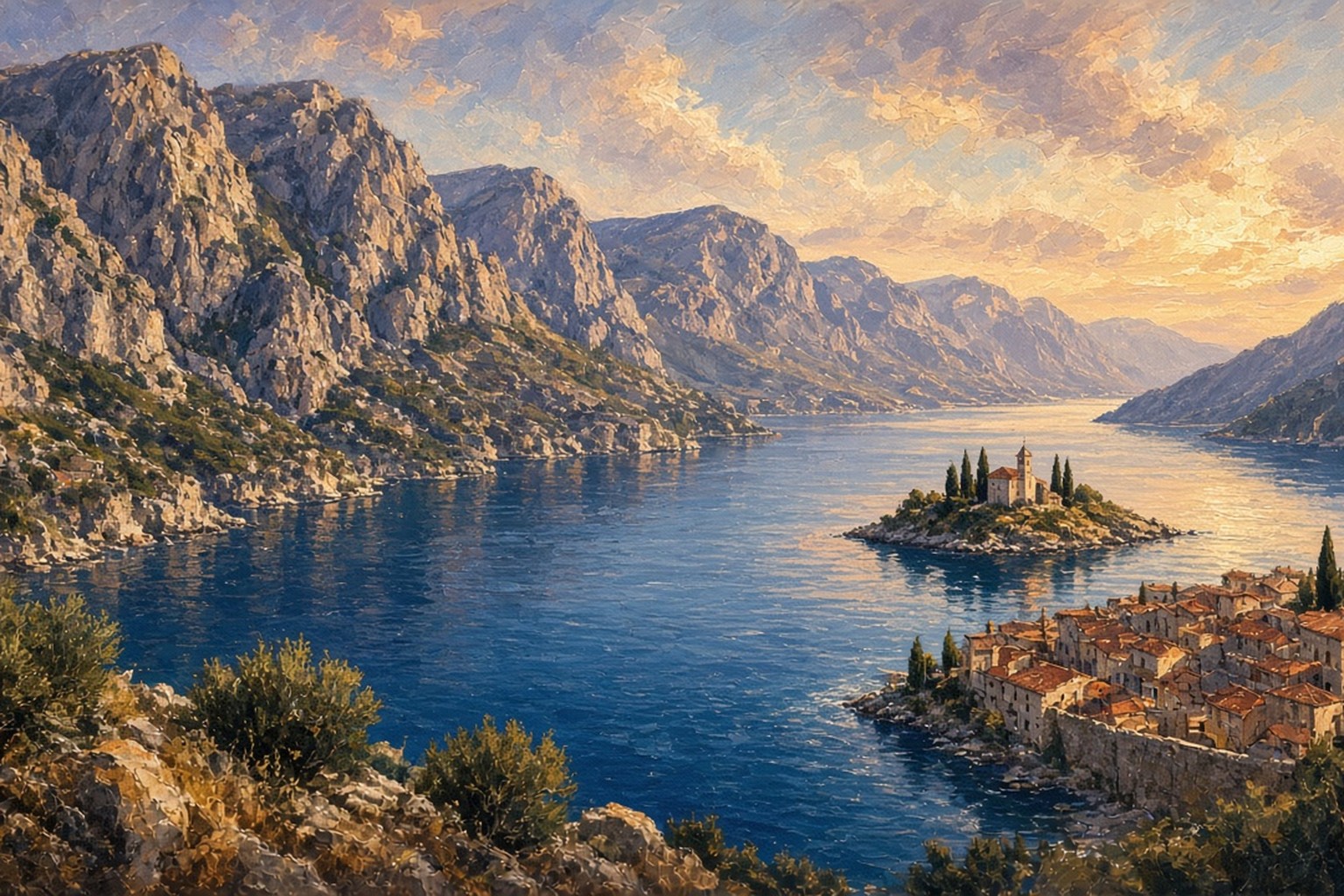
Montenegro is a small, mountainous country in Southeastern Europe, stretching from the sparkling Adriatic Sea to rugged peaks in the Balkan interior. Its name means “Black Mountain,” after the dark forests that once covered Mount Lovćen. With dramatic bays, medieval towns, deep canyons, and warm hospitality, Montenegro is one of the most beautiful countries in Europe.
Geography and Climate
Montenegro covers about 13,800 square kilometers and is bordered by Croatia, Bosnia and Herzegovina, Serbia, Kosovo, and Albania. Its coastline on the Adriatic Sea is short but spectacular, with sandy beaches, rocky coves, and the fjord-like Bay of Kotor.
Behind the coast, limestone mountains rise steeply, and peaks in the Durmitor and Prokletije ranges reach more than 2,500 meters. The Tara River Canyon is one of the deepest canyons in Europe, while Lake Skadar, shared with Albania, is the largest lake in the Balkans and an important home for birds.
The coast has a Mediterranean climate with hot, dry summers and mild, rainy winters. Inland, the climate becomes more continental, and the high mountains receive heavy snow in winter. This variety allows visitors to swim in the sea and ski in the mountains within the same country.
History and Independence
In ancient times, the region was home to Illyrian tribes before becoming part of the Roman Empire. In the Middle Ages, the state of Duklja, later known as Zeta, developed here, and Montenegro’s mountains helped its people preserve a strong sense of independence during the centuries of Ottoman expansion.
From 1696, Montenegro was ruled by prince-bishops of the Petrović-Njegoš family, including Petar II Petrović-Njegoš, a celebrated poet and author of “The Mountain Wreath.” Montenegro’s independence was internationally recognized at the Congress of Berlin in 1878, and it became a kingdom under Nikola I in 1910.
After the First World War, Montenegro joined the Kingdom of Serbs, Croats and Slovenes, which later became Yugoslavia. Following a referendum, it regained its independence on 3 June 2006. Montenegro joined NATO in 2017 and is a candidate for membership in the European Union.
Economy and Natural Resources
Tourism is the most important part of Montenegro’s economy, with visitors drawn to its beaches, historic towns, and national parks. Hotels, restaurants, and services along the coast provide many jobs, especially in summer.
The country produces electricity from hydropower on its fast-flowing rivers, and it has deposits of bauxite, which supported a long tradition of aluminum production. The Port of Bar is an important gateway for trade, linked by railway to Serbia.
Agriculture includes olives, grapes, citrus fruits, and livestock, and local wines such as Vranac are increasingly known abroad. Although Montenegro is not a member of the European Union, it uses the euro as its currency.
Culture and Language
The official language is Montenegrin, and Serbian, Bosnian, Albanian, and Croatian are also in official use. Most people are Orthodox Christians, with significant Muslim and Catholic communities, reflecting the country’s diverse heritage.
Epic poetry sung to the gusle, a traditional one-stringed instrument, has long preserved stories of heroes and history. Folk dances such as the oro, a circle dance with singing, are performed at weddings and festivals.
Montenegrins place great value on family, honor, and hospitality. Coastal towns celebrate summer carnivals and festivals of music and film, while mountain villages keep traditions of shepherding, crafts, and homemade food alive. The capital, Podgorica, is the country’s largest city and its political and cultural center, while the old royal capital, Cetinje, is home to museums, monasteries, and former embassies.
Food and Cuisine
Montenegrin cuisine combines Mediterranean flavors from the coast with hearty mountain dishes from the interior. Njeguški pršut, a smoked and air-dried ham from the village of Njeguši, is one of the country’s most famous specialties, often served with local cheese and olives.
In the mountains, people enjoy kačamak, a creamy dish of cornmeal or potatoes cooked with cheese and kajmak, a rich dairy spread. On the coast, fresh fish, mussels, and black risotto made with squid ink are favorites, while carp and eel from Lake Skadar are local delicacies.
Meals are often accompanied by red Vranac wine or a glass of rakija, a fruit brandy offered to guests as a sign of welcome. Fresh bread, honey, figs, and pomegranates add sweetness to the Montenegrin table.
Tourism and Attractions
The old town of Kotor, with its medieval walls climbing the mountainside above the bay, is part of a UNESCO World Heritage Site. Nearby Perast, with its baroque palaces and the island church of Our Lady of the Rocks, is one of the most charming towns on the Adriatic.
Budva is known for its lively beaches and walled old town, while the islet of Sveti Stefan is an iconic sight on the coast. Inland, the Ostrog Monastery, built into a sheer cliff, is an important place of pilgrimage.
Durmitor National Park, also a UNESCO World Heritage Site, offers hiking, rafting on the Tara River, and glacial lakes such as the Black Lake. Biogradska Gora protects one of the last primeval forests in Europe, and Lovćen National Park is home to the mausoleum of Njegoš.
Challenges and Opportunities
Montenegro faces challenges such as the seasonal nature of tourism, unemployment in the north, and pressure from construction along the coast. Strengthening the rule of law and completing reforms for European Union membership remain key priorities.
At the same time, its stunning nature, strategic location, and growing reputation as a travel destination offer great opportunities. Eco-tourism, renewable energy, and quality local products could help spread prosperity across the whole country.
Better roads and rail links, including the modern highway connecting Podgorica with the north, are making remote mountain areas easier to reach. Extending the tourist season into spring and autumn could bring more steady income to local communities.
Where Black Mountains Meet the Adriatic
Montenegro is a land where towering mountains plunge into shimmering bays and history lives in every stone. From the walls of Kotor and the beaches of Budva to the canyons of Durmitor and the calm waters of Lake Skadar, it offers beauty in every direction. Wild, welcoming, and full of character, Montenegro is a true treasure of the Adriatic.