
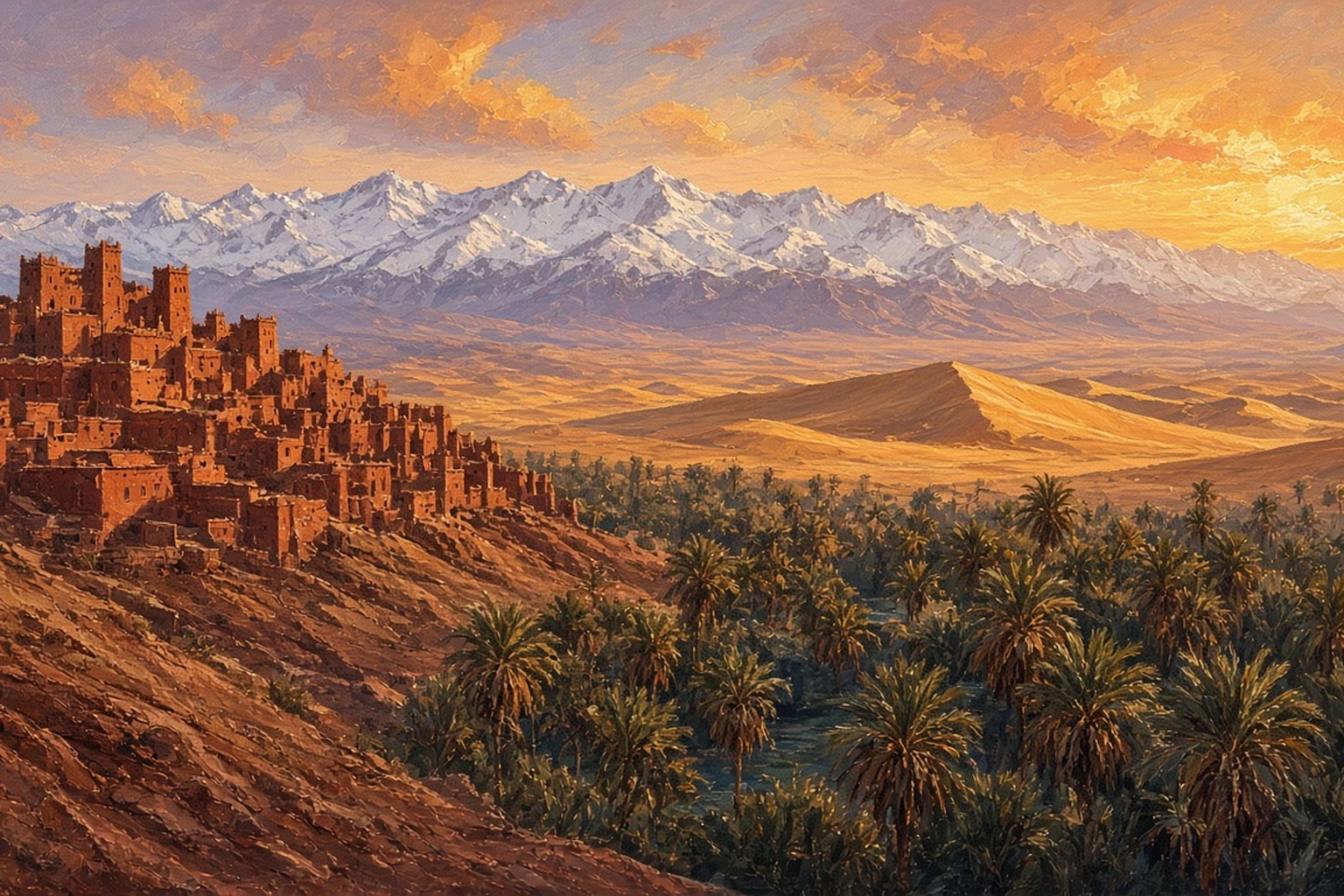
Morocco is a captivating kingdom in North Africa, where the Atlas Mountains, the Sahara Desert, and the coasts of the Atlantic Ocean and the Mediterranean Sea meet. Known for its colorful medinas, fragrant spice markets, and ancient imperial cities, it has long been a crossroads of Africa, Europe, and the Arab world. With its rich traditions, famous cuisine, and warm hospitality, Morocco is one of the most enchanting destinations on Earth.
Geography and Climate
Morocco lies in the northwest corner of Africa, just across the Strait of Gibraltar from Spain. It has long coastlines on both the Atlantic Ocean and the Mediterranean Sea, and it borders Algeria to the east.
The country is crossed by several mountain ranges, including the Rif in the north and the Middle Atlas, High Atlas, and Anti-Atlas further south. Mount Toubkal, at about 4,167 meters, is the highest peak in North Africa. Beyond the mountains, the land opens into rocky plateaus, palm-filled oases, and the golden dunes of the Sahara, such as Erg Chebbi near Merzouga.
The climate varies from Mediterranean along the northern coast to semi-arid and desert in the south and east. Coastal cities enjoy mild weather thanks to Atlantic breezes, while the mountains receive snow in winter. In the desert, days can be very hot and nights surprisingly cool.
History and Independence
The Amazigh, or Berber, peoples have lived in Morocco for thousands of years. Phoenicians and Carthaginians founded trading posts on the coast, and the Romans later ruled the region, leaving behind impressive ruins such as Volubilis.
Arab armies brought Islam in the seventh century, and in 788 Idris I founded the first Moroccan Islamic dynasty. Great dynasties such as the Almoravids, who founded Marrakesh, the Almohads, the Marinids, and the Saadians followed, and the Alaouite dynasty, which still reigns today, rose to power in the seventeenth century. The University of al-Qarawiyyin in Fez, founded in 859 by Fatima al-Fihri, is often described as one of the oldest continuously operating universities in the world.
In 1912, most of Morocco became a French protectorate, while Spain controlled zones in the north and south. Morocco regained its independence in 1956 under King Mohammed V. King Mohammed VI has reigned since 1999, and a new constitution was adopted in 2011.
Economy and Natural Resources
Morocco holds the world’s largest reserves of phosphate rock, which is used to make fertilizers and is one of the country’s most important exports. Agriculture is also vital, producing citrus fruits, olives, tomatoes, dates, and argan oil from trees that grow naturally in the southwest.
In recent decades, Morocco has become a major center for car and aircraft parts manufacturing, especially around Tangier, home to the large Tanger Med port. Tourism, textiles, fishing, and remittances from Moroccans abroad also support the economy.
The country is investing heavily in renewable energy, including the vast Noor Ouarzazate solar complex and many wind farms. These projects aim to reduce dependence on imported fuel and make Morocco a leader in clean energy in Africa.
Culture and Language
Arabic and Amazigh are the official languages, while Moroccan Arabic, known as Darija, is spoken in daily life and French is widely used in business and education. Islam is the main religion, and Ramadan and Eid celebrations bring families together.
Moroccan art and architecture are famous for zellige mosaic tiles, carved plaster, painted cedar wood, and elegant courtyard homes called riads. Skilled artisans produce leather goods, carpets, pottery, and brass lanterns in workshops across the medinas.
Music is everywhere, from Andalusian classical traditions to Amazigh folk songs and the spiritual rhythms of Gnawa music, which is recognized by UNESCO. The Jemaa el-Fnaa square in Marrakesh, filled with storytellers, musicians, and food stalls, is celebrated as a masterpiece of living heritage.
Food and Cuisine
Moroccan cuisine is one of the most celebrated in the world, blending Amazigh, Arab, Andalusian, and African influences. Tagine, a slow-cooked stew named after the cone-shaped clay pot in which it is made, combines meat or vegetables with spices, olives, preserved lemons, or dried fruit.
Couscous is traditionally served on Fridays with vegetables and meat, and pastilla, a flaky pie filled with chicken or pigeon, almonds, and cinnamon, is a festive favorite. During Ramadan, harira, a hearty soup of tomatoes, lentils, and chickpeas, is often eaten to break the fast.
Sweet mint tea, poured from a height into small glasses, is a symbol of Moroccan hospitality. Markets overflow with olives, dates, fresh bread, and spices such as cumin, saffron, and ras el hanout.
Tourism and Attractions
Marrakesh enchants visitors with its lively medina, the Koutoubia Mosque, and beautiful gardens such as the Jardin Majorelle. Fez el Bali, one of the largest car-free urban areas in the world, is a maze of ancient lanes, tanneries, and historic schools.
The blue-painted town of Chefchaouen in the Rif Mountains, the fortified village of Aït Benhaddou, and the Roman ruins of Volubilis are also popular sites. In Casablanca, the Hassan II Mosque rises dramatically over the Atlantic Ocean, while the capital, Rabat, offers the Kasbah of the Udayas and the historic Hassan Tower.
Adventurous travelers can trek in the High Atlas, ride camels across the dunes of the Sahara, and sleep under the stars in desert camps. The breezy coastal town of Essaouira is known for its sea walls, art galleries, and windsurfing.
Challenges and Opportunities
Morocco faces challenges such as water scarcity, recurring droughts, youth unemployment, and differences in development between cities and rural areas. Rebuilding mountain communities after the 2023 Al Haouz earthquake has also been an important national effort.
At the same time, its strategic location, modern infrastructure, and growing industries offer great opportunities. Investments in renewable energy, high-speed rail, and tourism, along with co-hosting the 2030 FIFA World Cup, are helping Morocco build a bright future.
Where the Atlas Meets the Atlantic
Morocco is a land of snowy peaks, golden dunes, and timeless cities filled with color and sound. From the busy squares of Marrakesh and the ancient lanes of Fez to the blue streets of Chefchaouen and the quiet beauty of the Sahara, it offers unforgettable experiences at every turn. Vibrant, welcoming, and full of wonder, Morocco is a true jewel of North Africa.