
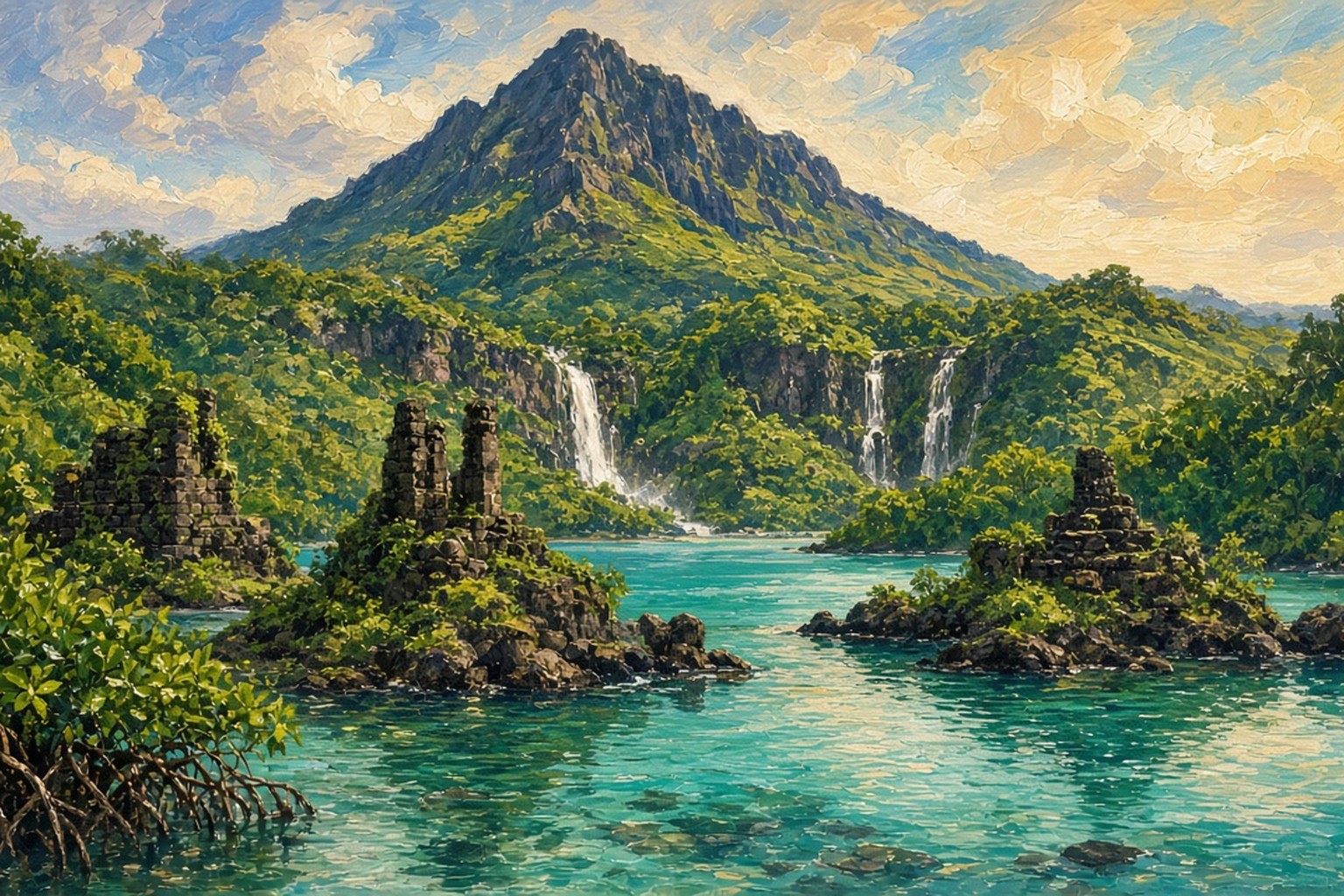
Micronesia, officially the Federated States of Micronesia, is an island nation in the western Pacific Ocean made up of hundreds of islands spread across a vast expanse of sea. Its four states, Yap, Chuuk, Pohnpei, and Kosrae, each have their own languages, customs, and character. With lush volcanic islands, coral atolls, ancient stone ruins, and legendary diving, Micronesia is a remarkable and little-known corner of the world.
Geography and Climate
The Federated States of Micronesia consists of around 600 islands in the Caroline Islands, stretching for roughly 2,700 kilometers from east to west. The total land area is only about 700 square kilometers, but the country’s waters cover an enormous area of the Pacific.
The islands range from high volcanic islands with mountains, rainforests, and waterfalls to low coral atolls barely above sea level. Pohnpei is the largest island and home to the capital, Palikir, while Chuuk Lagoon is one of the largest enclosed lagoons in the world. Kosrae is known for its green mountains and mangrove forests.
Micronesia has a tropical climate that is warm and humid throughout the year. Rainfall is abundant, and Pohnpei is often described as one of the wettest places on Earth. Typhoons can occasionally strike the islands, especially in the western states. Coral reefs and mangroves around the islands help protect the coastlines and support abundant marine life.
History and Independence
The islands were settled thousands of years ago by skilled seafarers who navigated using the stars, winds, and ocean swells. On Pohnpei, the Saudeleur dynasty built Nan Madol, a ceremonial and political center made of massive basalt columns on artificial islets in a coral lagoon.
Spain claimed the Caroline Islands in the nineteenth century, then sold them to Germany in 1899. After World War I, the islands came under Japanese administration, and during World War II, Chuuk Lagoon was a major Japanese naval base that was heavily attacked by American forces in 1944.
After the war, the islands became part of the United Nations Trust Territory of the Pacific Islands, administered by the United States. Micronesia adopted its constitution in 1979, entered a Compact of Free Association with the United States in 1986, and joined the United Nations in 1991.
Economy and Natural Resources
Micronesia’s economy is small and relies significantly on assistance from the United States under the Compact of Free Association. The United States dollar is the official currency, and government services are a major source of employment.
The surrounding ocean is the country’s most valuable resource, and fees from foreign fishing fleets, especially for tuna, provide important revenue. Many families also depend on subsistence farming and fishing for their daily needs.
Crops such as breadfruit, bananas, taro, coconuts, and black pepper are grown on the high islands. Tourism, especially diving, has potential for growth, though the islands’ remote location makes travel costly.
Culture and Language
English is the official language, while each state has its own main local languages, including Chuukese, Pohnpeian, Yapese, and Kosraean. Christianity is practiced by most of the population, and churches play an important role in community life.
Traditional customs remain strong, especially in Yap, where people maintain village hierarchies, traditional dress, and colorful dances. Yap is famous for its stone money, large carved discs of limestone that were transported by canoe from distant islands and are still used in important traditional exchanges.
Micronesia is also renowned for its traditional navigation. The master navigator Mau Piailug, from the island of Satawal in Yap State, helped revive the art of ocean voyaging across the Pacific in the 1970s by guiding the Hawaiian canoe Hōkūleʻa without instruments.
Food and Cuisine
Traditional Micronesian food is based on what the land and sea provide. Breadfruit, taro, yams, bananas, and coconut are staples, often cooked in earth ovens or boiled and pounded into a soft paste.
Fresh fish, reef fish, crabs, and other seafood are central to the diet, eaten grilled, boiled, or raw with lime and coconut milk. Rice, canned meats, and other imported foods have also become common in towns.
On Pohnpei, sakau, a drink made from the roots of the kava plant, is shared at ceremonies and social gatherings. Betel nut chewing is a common social custom in Yap, and feasts with abundant food mark weddings, funerals, and celebrations.
Tourism and Attractions
Nan Madol, a UNESCO World Heritage Site, is the country’s most famous attraction, with its mysterious basalt walls and canals rising from the lagoon off Pohnpei. Visitors to Pohnpei can also hike to waterfalls, climb Sokehs Rock, and explore lush rainforest.
Chuuk Lagoon is one of the world’s best wreck diving destinations, with dozens of World War II ships and aircraft resting on the seabed, now covered with coral. Yap is famous for diving with manta rays, while Kosrae offers the ancient ruins of Lelu, quiet beaches, and pristine reefs.
Many visitors also enjoy kayaking through mangrove channels, surfing the powerful reef breaks of Pohnpei, and visiting traditional villages where local guides share stories, crafts, and customs. The relaxed pace of island life and the warmth of local communities leave a lasting impression on travelers.
Challenges and Opportunities
Micronesia faces challenges such as rising sea levels that threaten low-lying atolls, limited economic opportunities, and dependence on outside assistance. The distances between islands also make transportation and services difficult to provide.
At the same time, its rich marine resources, unique cultural heritage, and unspoiled natural beauty offer real opportunities. Investments in sustainable fisheries, renewable energy, and eco-tourism could help strengthen the economy and protect the islands for future generations.
Strengthening education, health care, and transport links between the states remains a national priority. Traditional knowledge of the land and sea is also helping communities find solutions to environmental change.
A Constellation of Island Cultures
Micronesia is a nation of scattered islands united by the ocean and a deep respect for tradition. From the ancient stone city of Nan Madol to the wrecks of Chuuk Lagoon and the stone money of Yap, it offers experiences found nowhere else. Peaceful, diverse, and welcoming, Micronesia is a true hidden treasure of the Pacific.