
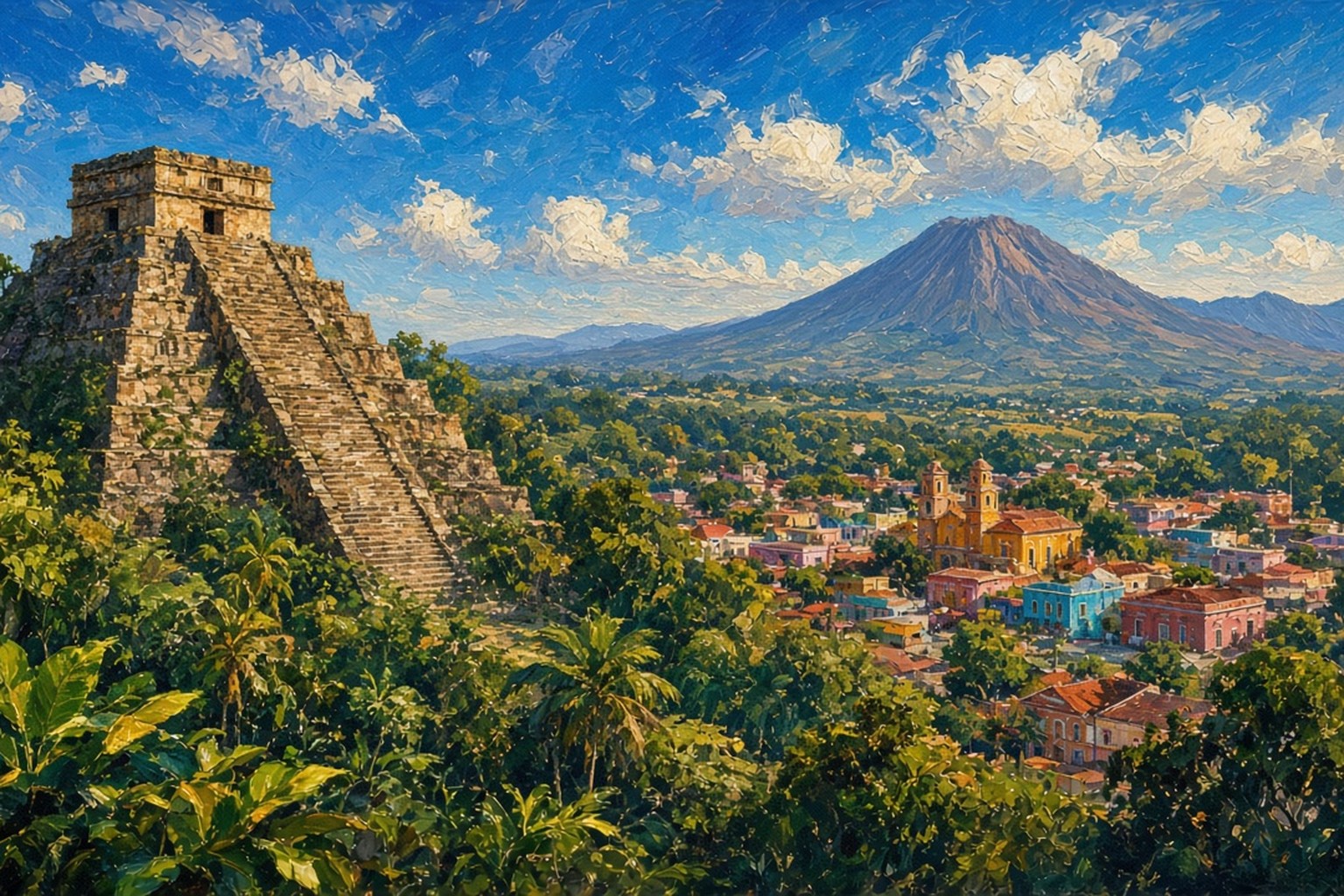
Mexico is a vast and vibrant country in North America, stretching from the deserts of the north to the tropical jungles and beaches of the south. It is home to ancient civilizations such as the Olmec, Maya, and Aztec, whose pyramids and cities still inspire wonder today. With its colorful traditions, world-famous cuisine, and warm hospitality, Mexico is one of the most captivating nations on Earth.
Geography and Climate
Mexico covers nearly two million square kilometers, making it one of the largest countries in the Americas. It is bordered by the United States to the north and by Guatemala and Belize to the southeast, with long coastlines on the Pacific Ocean, the Gulf of Mexico, and the Caribbean Sea.
Much of the country is dominated by highlands and mountains, including the Sierra Madre Occidental and the Sierra Madre Oriental, which frame the central plateau. A belt of volcanoes crosses central Mexico, and the highest peak, Pico de Orizaba, rises to about 5,636 meters. The country also includes the long Baja California peninsula and the flat limestone Yucatán Peninsula, famous for its cenotes, natural sinkholes filled with water.
Mexico’s climate varies greatly, from hot deserts in the north to temperate highlands and humid tropical lowlands in the south. Much of the country has a rainy season from about June to October, and coastal areas can be affected by hurricanes. Mexico is one of the world’s most biodiverse countries.
History and Independence
Mexico was the birthplace of several great civilizations. The Olmec flourished along the Gulf Coast, the city of Teotihuacan became one of the largest in the ancient world, and the Maya built remarkable cities across the south. In the fourteenth century, the Aztecs founded their capital, Tenochtitlan, on an island in Lake Texcoco, where Mexico City stands today.
Spanish forces led by Hernán Cortés conquered the Aztec Empire between 1519 and 1521, and the region became the colony of New Spain for three centuries. On 16 September 1810, the priest Miguel Hidalgo called for independence, beginning a long struggle that ended with Mexico’s independence in 1821.
In the nineteenth century, Mexico lost a large part of its territory after a war with the United States and resisted a French intervention, remembered in the victory at Puebla on 5 May 1862. The Mexican Revolution, which began in 1910, transformed the country’s politics and society. Today, Mexico is a federal republic made up of 31 states and Mexico City.
Economy and Natural Resources
Mexico has one of the largest economies in Latin America and is a major manufacturing power. Factories produce cars, electronics, appliances, and medical devices, many of them exported to the United States under a regional trade agreement with the United States and Canada.
The country is rich in natural resources, including oil, natural gas, and minerals, and it is the world’s largest producer of silver. Agriculture is also important, and Mexico is a leading exporter of avocados, tomatoes, berries, and other fresh produce.
Tourism is a major industry, attracting tens of millions of visitors to beaches, colonial cities, and archaeological sites. Remittances from Mexicans living abroad are another important source of income for many families.
Culture and Language
Spanish is spoken by the vast majority of Mexicans, and Mexico has the largest Spanish-speaking population in the world. The government also recognizes dozens of indigenous languages, such as Nahuatl and Yucatec Maya, which are spoken by millions of people. Most Mexicans are Roman Catholic, and the Basilica of Our Lady of Guadalupe is one of the most visited religious sites in the world.
The Day of the Dead, celebrated at the beginning of November, honors departed loved ones with colorful altars, marigold flowers, and sugar skulls, and it is recognized by UNESCO. Mariachi music, with its violins, trumpets, and guitars, is also part of UNESCO’s intangible cultural heritage.
Mexico has a rich artistic tradition, from ancient sculpture to the murals of Diego Rivera and the paintings of Frida Kahlo. Folk art such as Talavera pottery, woven textiles, and alebrijes, brightly painted fantasy creatures, are admired around the world.
Food and Cuisine
Traditional Mexican cuisine was recognized by UNESCO as intangible cultural heritage in 2010, the first national cuisine to receive this honor. Corn, beans, and chili peppers form its foundation, and tortillas accompany almost every meal.
Tacos, filled with grilled meats, seafood, or vegetables, are enjoyed everywhere, while tamales, enchiladas, and pozole are beloved traditional dishes. Mole, a rich sauce made with chilies, spices, and sometimes chocolate, is especially famous in Puebla and Oaxaca.
Chiles en nogada, stuffed peppers topped with walnut sauce and pomegranate seeds, is a festive dish served around Independence Day. Guacamole, fresh salsas, and drinks such as tequila, mezcal, and hot chocolate complete a cuisine celebrated worldwide.
Tourism and Attractions
Mexico has more UNESCO World Heritage Sites than any other country in the Americas. Highlights include the Maya city of Chichén Itzá with its great pyramid, the massive pyramids of Teotihuacan, and the ancient Zapotec city of Monte Albán near Oaxaca.
The historic center of Mexico City, built on the ruins of Tenochtitlan, is filled with grand plazas, museums, and colonial architecture. Colonial cities such as Guanajuato, San Miguel de Allende, and Puebla charm visitors with colorful streets and churches.
Beach lovers flock to Cancún, Tulum, and the Riviera Maya on the Caribbean coast, as well as Puerto Vallarta and Los Cabos on the Pacific. Adventurers can explore the Copper Canyon, swim in cenotes, or watch millions of monarch butterflies in the forests of Michoacán.
Challenges and Opportunities
Mexico faces challenges including violence linked to organized crime, income inequality, and water shortages in some regions. Protecting forests, coastlines, and biodiversity from development and climate change is also a pressing concern.
At the same time, its young population, strategic location, and strong manufacturing base offer great opportunities. Growing investment in industry, renewable energy, and sustainable tourism could help Mexico build a more prosperous future.
A Land of Color and Heritage
Mexico is a land where ancient pyramids rise from jungles and colorful festivals fill the streets with music and life. From the bustling heart of Mexico City to the Caribbean shores of the Yucatán and the deserts and canyons of the north, it offers endless discoveries. Rich in culture, flavor, and warmth, Mexico is a truly unforgettable destination.