
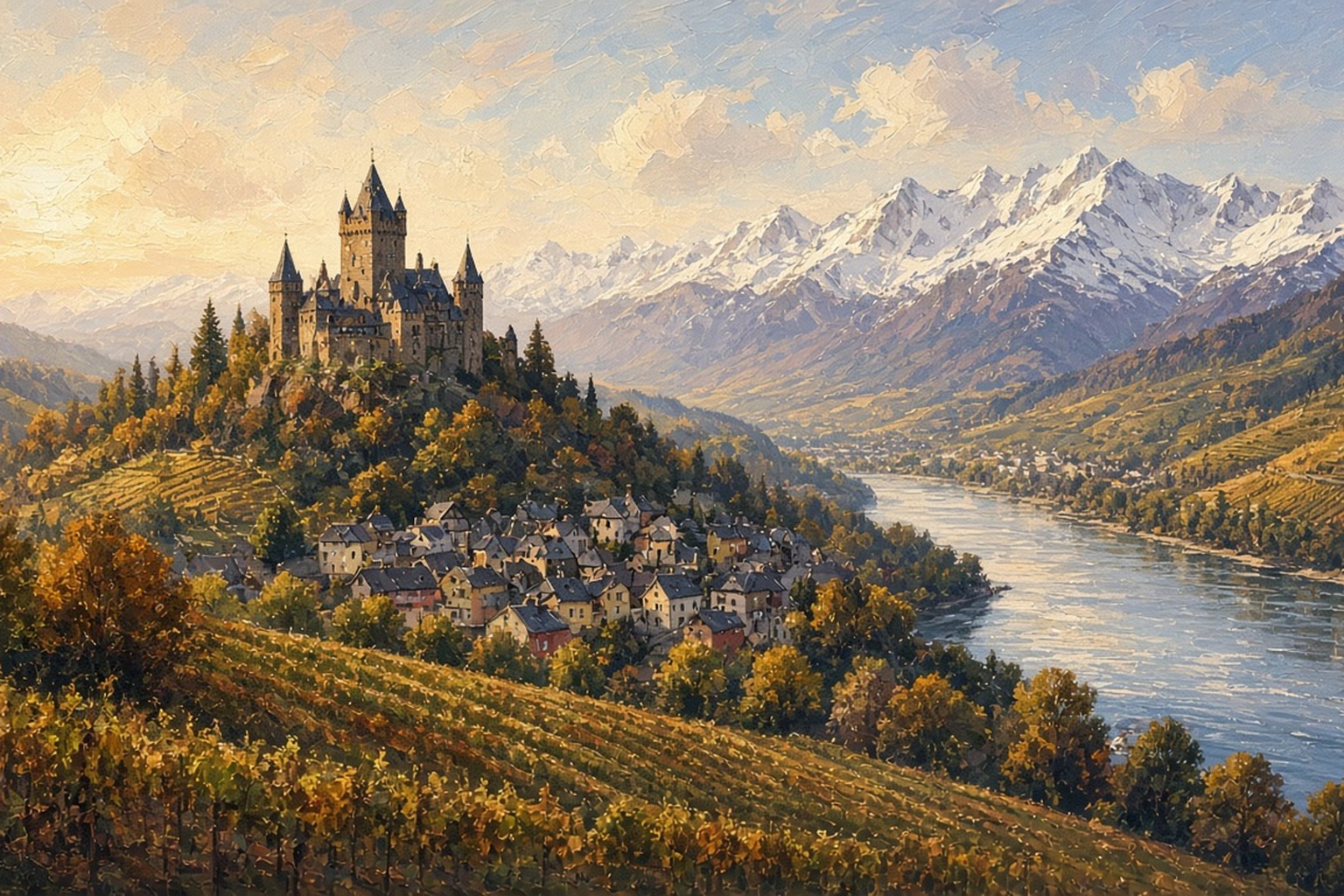
Liechtenstein is a tiny principality nestled in the Alps between Switzerland and Austria. One of the smallest countries in the world, it is known for its fairy-tale castles, mountain scenery, and remarkable prosperity. With charming villages, excellent hiking, and a proud royal heritage, Liechtenstein proves that great experiences can come in very small packages.
Geography and Climate
Liechtenstein covers only about 160 square kilometers, making it the sixth-smallest country in the world. It is one of only two doubly landlocked countries, meaning it is surrounded entirely by other landlocked nations, Switzerland to the west and south and Austria to the east.
The Rhine River forms the western border, and its broad valley holds most of the country’s towns, farms, and roads. To the east, the land rises steeply into the Rätikon range of the Alps, where the highest peak, the Grauspitz, reaches about 2,600 meters.
The country has a mild alpine climate, influenced by the warm föhn wind that blows down from the mountains. Summers are pleasant and green, while winters bring snow to the higher elevations, creating perfect conditions for skiing. The valley floor enjoys a sunny and relatively gentle climate that allows vineyards and orchards to thrive.
History and Independence
In 1719, the Holy Roman Emperor Charles VI united the lordships of Vaduz and Schellenberg into the Principality of Liechtenstein, named after the princely family that had purchased them. For many years, the princes lived in Vienna and rarely visited their small territory.
Liechtenstein became sovereign in 1806 and gained full independence after the German Confederation dissolved in 1866. Two years later, it abolished its army, and it has remained neutral ever since. After World War I, the country formed close ties with Switzerland, entering a customs union in 1923 and adopting the Swiss franc.
In 1938, the princely family moved permanently to Vaduz Castle, which remains their home today. Liechtenstein joined the United Nations in 1990 and the European Economic Area in 1995. It is a constitutional monarchy in which the prince and the people share power, with frequent use of direct democracy.
Economy and Natural Resources
Despite its small size, Liechtenstein has one of the highest incomes per person in the world. Its economy is highly industrialized, with companies producing precision tools, machinery, vehicle components, and dental products sold around the globe.
Financial services, including banking and asset management, are another important sector, and the country has worked to strengthen transparency in recent decades. Low taxes and a business-friendly environment have attracted many companies to establish their headquarters there.
Because the population is small, more than half of the workforce commutes daily from neighboring Switzerland, Austria, and Germany. Agriculture, including dairy farming and vineyards, also continues on a smaller scale in the Rhine Valley.
Culture and Language
German is the official language, but most people speak a local Alemannic dialect in everyday life. The majority of the population is Roman Catholic, and religious traditions shape many local festivals and holidays.
National Day, celebrated on 15 August, is the highlight of the year, when the princely family invites the public to the castle gardens and fireworks light up the sky over Vaduz. Local music societies, choirs, and brass bands play an important role in community life.
The country is also known for its museums and art collections. The Kunstmuseum Liechtenstein displays modern and contemporary art, while the Postage Stamp Museum celebrates the principality’s famous stamps, which are prized by collectors worldwide.
Food and Cuisine
Liechtenstein’s cuisine is similar to that of neighboring Switzerland and Austria, featuring cheese, potatoes, and hearty mountain dishes. The national specialty is Käsknöpfle, small cheese dumplings topped with fried onions and often served with applesauce or potato salad.
Ribel, a traditional dish made from cornmeal, was once a daily staple for farming families and is still enjoyed today. Local wineries in the Rhine Valley, including the prince’s own vineyard in Vaduz, produce fine wines such as Pinot Noir.
Bakeries offer delicious breads, cakes, and pastries, and cozy mountain restaurants serve warming meals after a day of hiking or skiing. Fresh local cheese, cured meats, and seasonal game dishes complete the alpine flavors.
Many restaurants take pride in using regional ingredients, and farmers’ markets offer local honey, fruit, and dairy products. A glass of local wine paired with a plate of Käsknöpfle is a classic way to experience the flavors of the principality.
Tourism and Attractions
Vaduz, the capital, is a small and charming town overlooked by Vaduz Castle, perched on a hillside above the center. Visitors can stroll through the pedestrian zone, visit museums, and enjoy sweeping views of the Rhine Valley and the Swiss mountains beyond.
Gutenberg Castle in Balzers, the mountain resort of Malbun, and scenic routes such as the Liechtenstein Trail, which crosses all eleven municipalities, are popular with visitors. Hikers can also explore the dramatic Fürstensteig path along the mountain cliffs.
In winter, Malbun offers family-friendly ski slopes, sledding, and snowshoe trails, while in summer the same mountains are covered with wildflowers. Cycling paths along the Rhine and the vineyards around Vaduz make it easy to explore the valley at a relaxed pace.
Challenges and Opportunities
Liechtenstein faces challenges linked to its small size, including limited land for housing, traffic from cross-border commuters, and dependence on foreign markets. Maintaining its financial reputation is also an ongoing priority.
At the same time, its stable government, skilled workforce, and innovative industries give it great strength. Investments in research, sustainability, and tourism help ensure continued prosperity for the principality.
The principality also plays an active role in international cooperation, supporting humanitarian projects and environmental initiatives. Its compact size allows new ideas in public transport and renewable energy to be tested and adopted quickly.
A Small Principality with a Big Heart
Liechtenstein is a land of castles, mountains, and quiet villages, where tradition and innovation live side by side. From the royal heights of Vaduz to the alpine trails above Malbun, it offers beauty and charm at every turn. Small in size yet rich in character, Liechtenstein is a true jewel of the Alps.