
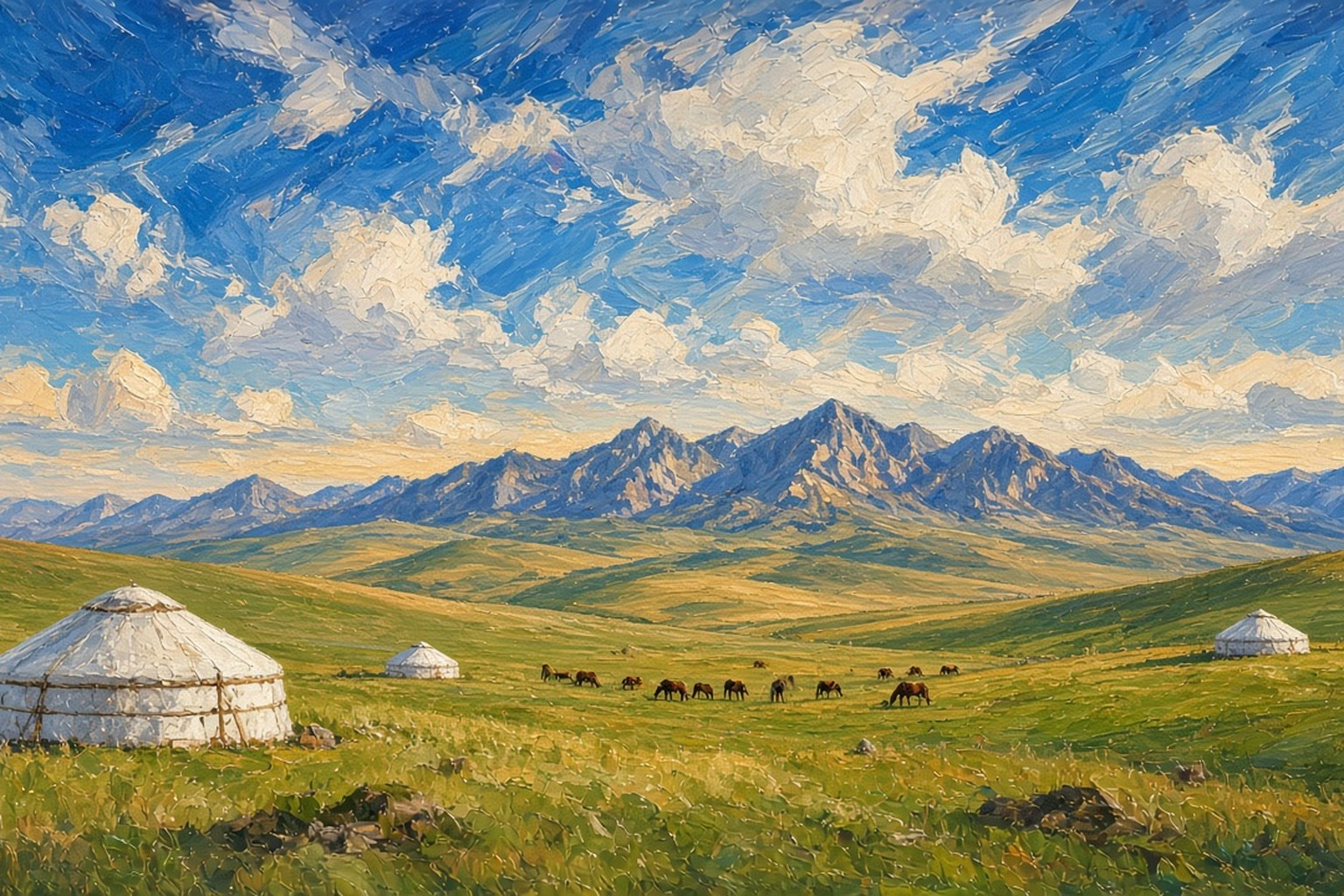
Mongolia is a vast, landlocked country in East Asia, set between Russia to the north and China to the south. Known as the “Land of the Eternal Blue Sky,” it is a place of endless grasslands, rugged mountains, and the sweeping Gobi Desert. With its proud nomadic heritage, legendary history, and warm hospitality, Mongolia is one of the most remarkable destinations on Earth.
Geography and Climate
Mongolia covers about 1.56 million square kilometers, making it one of the largest landlocked countries in the world. With a relatively small population, it is also the most sparsely populated sovereign nation, and nearly half of its people live in the capital, Ulaanbaatar.
The landscape ranges from the snowy Altai Mountains in the west, where Khüiten Peak rises to about 4,374 meters, to the forested Khangai Mountains and the wide steppe of the center and east. In the south lies the Gobi Desert, with gravel plains, rocky ridges, and towering sand dunes. In the north, the deep, clear waters of Lake Khövsgöl are surrounded by taiga forest.
The climate is strongly continental, with long, very cold winters and short, warm summers. Ulaanbaatar is often described as the coldest national capital in the world. Rainfall is low, and the country is famous for its many bright, sunny days throughout the year.
History and Independence
For thousands of years, nomadic peoples such as the Xiongnu lived on the Mongolian steppe, herding animals and riding horses across the plains. In 1206, Temüjin united the Mongol tribes and took the title Genghis Khan, founding the Mongol Empire, which became the largest contiguous land empire in history.
His successors ruled from the capital Karakorum, and his grandson Kublai Khan founded the Yuan dynasty in China. After the empire declined, Mongolia gradually came under the control of the Qing dynasty, which ruled the region for about two centuries.
When the Qing dynasty collapsed in 1911, Mongolia declared independence, and after the revolution of 1921 it became the Mongolian People’s Republic in 1924, closely aligned with the Soviet Union. A peaceful democratic revolution in 1990 brought multiparty politics, and a new constitution was adopted in 1992.
Economy and Natural Resources
Mongolia has rich mineral resources, including copper, gold, coal, and fluorspar, and mining is the largest part of its economy. The giant Oyu Tolgoi copper and gold mine and the Tavan Tolgoi coal deposits in the Gobi are among the most important projects.
Livestock herding remains a way of life for many families, who raise sheep, goats, cattle, horses, and camels, often called the five snouts. Mongolia is one of the world’s leading producers of cashmere, which is made from the soft undercoat of its goats.
Services, construction, and tourism are growing, especially in Ulaanbaatar. Most exports go to China, and the country is working to diversify its economy and develop more processing industries at home.
Culture and Language
The official language is Mongolian, which is written mainly in the Cyrillic alphabet, while the traditional vertical Mongolian script is being revived in schools and official use. Tibetan Buddhism is the main religion, alongside long-standing shamanic traditions that honor nature and the sky.
Many herders still live in the ger, a round felt tent that can be taken down and moved with the seasons. Hospitality is deeply valued, and guests are traditionally welcomed with milk tea and food.
Mongolian music is world-famous for khöömii, or throat singing, and for the morin khuur, the horsehead fiddle, both recognized by UNESCO. The Naadam festival in July celebrates the three manly games of wrestling, horse racing, and archery, while Tsagaan Sar, the Lunar New Year, is the most important family holiday.
Food and Cuisine
Mongolian cuisine is shaped by the nomadic lifestyle and harsh climate, relying mostly on meat and dairy products. Buuz, steamed dumplings filled with mutton or beef, are a national favorite, especially during Tsagaan Sar, and khuushuur, fried meat pastries, are popular at Naadam.
Khorkhog, a festive dish of mutton cooked with hot stones in a sealed container, is often prepared for guests in the countryside. Dairy products such as dried curds, cream, and airag, a lightly fermented mare’s milk, are summer staples, and salty milk tea called suutei tsai is enjoyed every day.
In winter, families prepare hearty soups with noodles and dried meat to stay warm. Sharing food is an important sign of friendship, and meals are often enjoyed together around the stove in the center of the ger.
Tourism and Attractions
Ulaanbaatar is home to the Gandan Monastery, the central Sükhbaatar Square, and fascinating museums about Mongolian history and dinosaurs. Just outside the city, the giant Genghis Khan Equestrian Statue rises over the steppe, and Gorkhi-Terelj National Park offers rock formations, rivers, and green valleys.
In central Mongolia, the Orkhon Valley Cultural Landscape, a UNESCO World Heritage Site, includes the Erdene Zuu Monastery near the ruins of Karakorum. The Gobi Desert offers the singing sand dunes of Khongoryn Els and the Flaming Cliffs, where important dinosaur fossils have been discovered.
Travelers can also ride horses across open plains, stay with nomadic families in traditional gers, and watch eagle hunters in the western Altai region. Lake Khövsgöl in the north is a favorite destination for hiking, boating, and peaceful nature.
Challenges and Opportunities
Mongolia faces challenges such as winter air pollution in Ulaanbaatar, desertification, and dzud, severe winters that can threaten livestock and herders’ livelihoods. Its economy is also sensitive to changes in global commodity prices.
At the same time, strong sunshine and steady winds give Mongolia great potential for renewable energy. Its young, educated population, mineral wealth, and growing tourism sector offer real opportunities for a more balanced and prosperous future.
New roads, railways, and trade links with neighboring countries are gradually connecting remote regions to markets. Protecting pastures and supporting herding families will help preserve the nomadic culture that makes Mongolia so special.
A Land of Endless Steppe and Eternal Sky
Mongolia is a land of open horizons, where herds graze beneath a vast blue sky and the spirit of the nomads lives on. From the bustling streets of Ulaanbaatar to the quiet dunes of the Gobi and the shining waters of Lake Khövsgöl, it offers freedom and adventure at every turn. Proud, timeless, and welcoming, Mongolia is a truly unforgettable destination.