
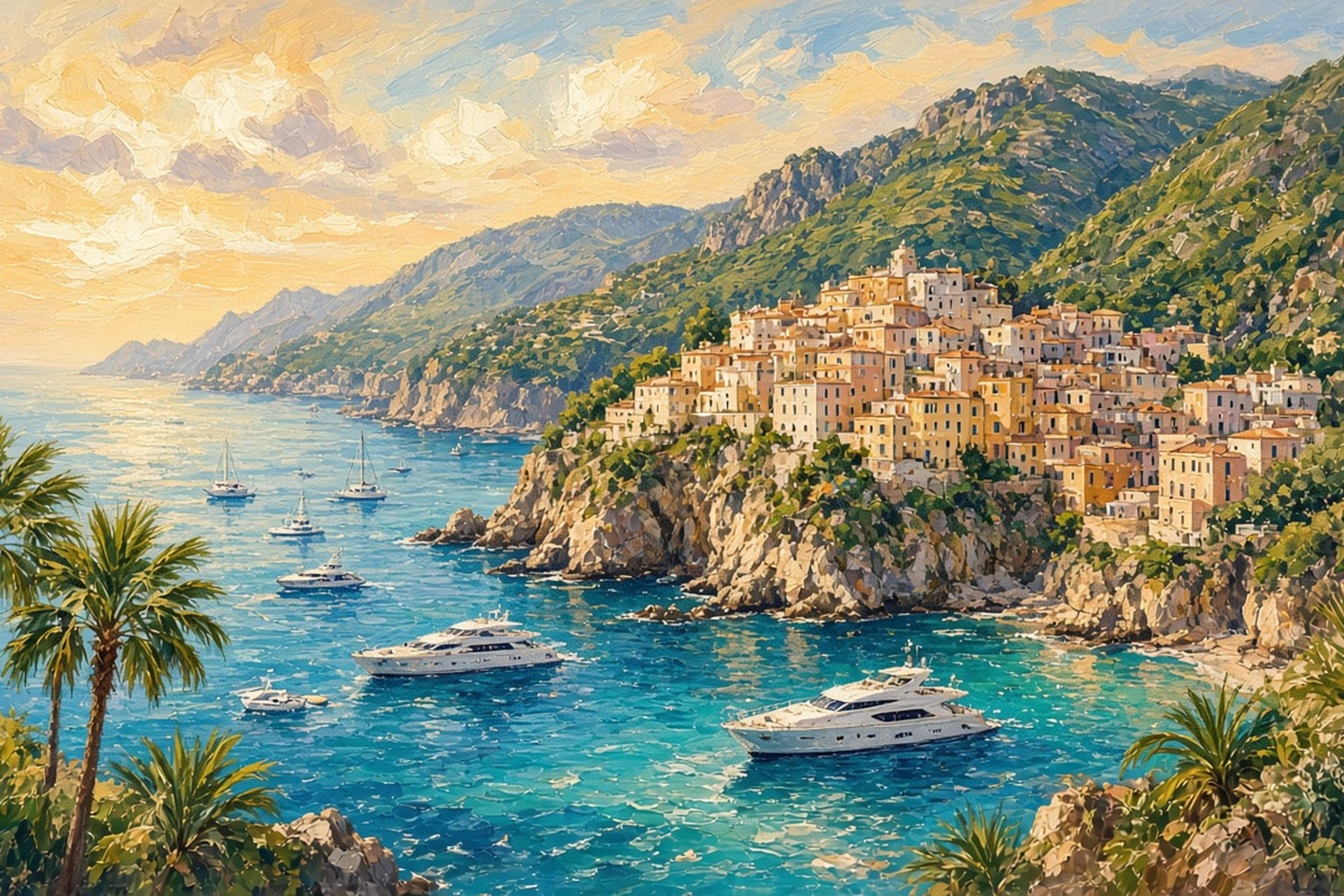
Monaco is a tiny, glamorous city-state on the French Riviera, set between rugged hills and the sparkling Mediterranean Sea. Ruled by the Grimaldi family for more than seven centuries, it is famous for its royal palace, its elegant casino, and the legendary Monaco Grand Prix. With its sunny harbor, beautiful gardens, and rich cultural life, Monaco is often called the “jewel of the Riviera.”
Geography and Climate
Monaco covers only about two square kilometers, making it the second-smallest country in the world after Vatican City. It is bordered by France on three sides and by the Mediterranean Sea on the fourth, and it lies just a short distance from the Italian border.
The principality is built on a steep, narrow strip of coastline backed by the foothills of the Alps. It is divided into districts such as Monaco-Ville, the old town on a rocky headland known as “the Rock,” Monte Carlo, La Condamine around the port, and Fontvieille, which was built on land reclaimed from the sea.
Monaco enjoys a mild Mediterranean climate, with hot, dry summers and gentle, sunny winters. Sea breezes keep temperatures pleasant for much of the year, and the mountains behind the city shelter it from cold northern winds. Bright light and blue skies have attracted visitors to this coast for generations.
History and Independence
In ancient times, Greek and Phoenician sailors used the natural harbor, and the Romans knew it as Portus Herculis Monoeci, the port of Hercules. In 1297, François Grimaldi famously captured the fortress on the Rock, according to legend while disguised as a monk, and his family has been linked to Monaco ever since.
Over the centuries, Monaco lived under the protection of Spain, France, and the Kingdom of Sardinia, and it was annexed by France during the French Revolution. In 1861, the Franco-Monegasque Treaty confirmed its sovereignty, while the nearby towns of Menton and Roquebrune became part of France.
Prince Charles III founded the casino district, which was named Monte Carlo in his honor in 1866. Prince Rainier III, who ruled from 1949 to 2005, modernized the economy and married the American actress Grace Kelly in 1956. Monaco joined the United Nations in 1993, and Prince Albert II has reigned since 2005.
Economy and Natural Resources
Monaco has very few natural resources, so its prosperity rests on tourism, banking, finance, and real estate. The principality is well known for having no personal income tax for most residents, which has attracted wealthy people and businesses from around the world.
Tourism and luxury hospitality are major employers, led by the historic Société des Bains de Mer, which operates the casino and several grand hotels. Conferences, trade fairs, and events such as the Monaco Yacht Show bring many visitors each year.
Although Monaco is not a member of the European Union, it uses the euro and has close economic ties with France. Because land is so scarce, the principality has expanded carefully into the sea, most recently with the new seaside district of Mareterra.
Culture and Language
French is the official language of Monaco, and Italian and English are widely spoken. The traditional Monégasque language, related to the Ligurian dialects of nearby Italy, is taught in schools and can still be seen on old street signs in Monaco-Ville.
Roman Catholicism is the state religion, and the feast of Saint Devota, the patron saint, is celebrated every January with a symbolic boat burning near her chapel. National Day, held on 19 November, is marked with ceremonies, music, and fireworks.
Monaco has a remarkably rich cultural scene for its size, including the Opéra de Monte-Carlo, the Monte-Carlo Philharmonic Orchestra, and the Ballets de Monte-Carlo. Sport is also central to its identity, especially the Monaco Grand Prix, which has been held on the city streets since 1929.
Food and Cuisine
Monégasque cuisine is rooted in the flavors of Provence and Liguria, with olive oil, fresh vegetables, herbs, and seafood. The national snack is barbagiuan, a small fried pastry filled with Swiss chard, ricotta, and herbs, which is especially popular on National Day.
Other local favorites include socca, a thin chickpea pancake, and stocafi, a hearty stew of dried cod cooked with tomatoes, olives, and wine. Fougasse monégasque, a sweet bread flavored with orange blossom and topped with anise seeds, is a festive treat.
Alongside these traditional dishes, Monaco is home to many world-class restaurants. Fresh fish from the Mediterranean, fragrant lemons from the Riviera, and fine French pastries are enjoyed in cafés throughout the principality.
Tourism and Attractions
The Prince’s Palace on the Rock is the official residence of the ruling family, and visitors gather each day to watch the changing of the guard. Nearby, the Monaco Cathedral holds the tombs of past princes and of Princess Grace, while the narrow lanes of the old town are lined with pastel houses.
The Oceanographic Museum, founded by Prince Albert I and perched dramatically on a cliff above the sea, is one of the finest marine museums in the world. The Monte Carlo Casino, the Exotic Garden with its cacti and succulents, and the yachts of Port Hercule are also highlights.
Each year, the principality hosts famous events such as the Grand Prix, the Monte-Carlo Rally, and the Monte-Carlo Television Festival. Larvotto Beach, the Princess Grace Rose Garden, and the Japanese Garden offer peaceful places to relax.
Challenges and Opportunities
Monaco’s greatest challenge is its lack of space, which makes housing very expensive and limits growth. Rising sea levels and the protection of the Mediterranean marine environment are also important concerns for a nation built along the shore.
At the same time, Monaco has become a voice for environmental protection, and the Prince Albert II Foundation supports projects on climate, biodiversity, and clean water around the world. Investments in green buildings, clean transport, and innovation are helping shape a more sustainable future.
A Sparkling Jewel of the Riviera
Monaco is a place where royal history, Mediterranean beauty, and modern glamour meet on a single rocky shore. From the palace and the Oceanographic Museum to the roar of the Grand Prix and the calm of its gardens, it offers wonder far greater than its size. Elegant, lively, and full of charm, Monaco shines as a true gem of the Riviera.