
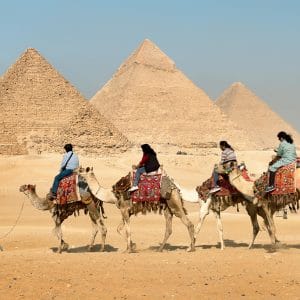
Egypt, a country linking northeast Africa with the Middle East, dates to the time of the pharaohs. Millennia-old monuments sit along the fertile Nile River Valley, including Giza’s colossal Pyramids and Great Sphinx as well as Luxor’s hieroglyph-lined Karnak Temple and Valley of the Kings tombs. Today, Egypt beckons with its rich history, cultural depth, and a treasure trove of archaeological wonders, making it a profound destination for historians, archeologists, and travelers alike.
Geography of Egypt
Egypt is predominantly desert, with the exception of the Nile Valley and Delta, which bisects the country from south to north. The Sahara Desert, the Libyan Desert, and the Sinai Peninsula are the major landforms outside this fertile strip. The country’s strategic location at the crossroads of Africa and Asia made it an imperial conquest for many empires throughout history. Egypt’s borders are with Israel to the northeast, the Red Sea to the east, Sudan to the south, Libya to the west, and the Mediterranean Sea to the north.
Climate
Characterized by its desert climate, most of Egypt experiences very low rainfall, extreme dryness, and significant temperature variations between day and night. The northern coast along the Mediterranean Sea receives the most rain, with an average of 8 inches of rainfall annually. Summer temperatures in Egypt frequently exceed 30°C (86°F) while winters are generally mild, making it a popular destination for tourists year-round.
History
Egypt’s history is among the longest continuous histories in the world. Ancient Egypt was a civilization of ancient Northeastern Africa, concentrated along the lower reaches of the Nile River, situated in the place that is now the country Egypt. It is one of six civilizations globally to arise independently. Egyptian civilization followed prehistoric Egypt and coalesced around 3100 BC (according to conventional Egyptian chronology) with the political unification of Upper and Lower Egypt under Menes (often identified with Narmer). The history of Egypt is typically divided into periods according to the dynasty of the ruling pharaoh. Today’s Egypt dates back to 1922, when it gained independence from the British Empire as a monarchy. Following a 1952 revolution, Egypt declared itself a republic and modernized rapidly.
Culture and Society
Egyptian culture is a unique blend of antiquity and modernity, influenced heavily by religion and tradition. The majority of Egyptians are Muslim, and Islam plays a central role in their daily lives. The rich cultural legacy of Egypt is reflected in its literature, music, dance, and art. Egypt also has a strong tradition in cinema, which has influenced an entire generation of filmmakers in the Arabic-speaking world. Arabic is the official language, and the Egyptian dialect is the most widely understood Arabic dialect across the Middle East, due to the popularity of Egyptian cinema and media.
Economy
Egypt’s economy is one of the most diversified in the Middle East, with sectors such as agriculture, industry, tourism, and services at almost equal production levels. The Suez Canal, a pivotal shipping lane connecting the Mediterranean Sea with the Red Sea, is a vital source of income for Egypt. Tourism also plays an integral part of Egypt’s economy with millions visiting the country annually to view its archaeological sites and natural wonders.
Tourist Attractions
Egypt is famed for its ancient monuments such as the Giza pyramid complex and its Great Sphinx. The southern city of Luxor contains numerous ancient artifacts, such as the Karnak Temple and the Valley of the Kings. Beyond the well-trodden path, Egypt’s coastline is dotted with resorts along the Red Sea and Mediterranean, offering diving and other water sports. In Cairo, the capital, Ottoman landmarks like Muhammad Ali Mosque and the Egyptian Museum offer insights into Egypt’s rich history.
From the labyrinthine streets of its bazaars to the majestic silence of the desert, Egypt offers a dive into its deep pools of ancient knowledge and scenic beauty. Visitors leave with a sense of having touched history and having been touched by the enduring legacy of one of humanity’s greatest civilizations.